Plywood vs. MDF: Why Built-In Carpentry Beats Loose Furniture in Singapore Homes
A complete durability, moisture resistance, and cost comparison for your HDB BTO, resale flat, or condo renovation.
- Built-In Carpentry Uses Plywood: Made from cross-laminated solid wood plies, plywood provides superior resistance to Singapore’s tropical humidity (70%–90% RH), holds heavier loads without sagging, and firmly grips door hinge screws.
- Loose Furniture Uses MDF / Particle Board: Made of compressed wood dust glued with resin. It is heavier yet more brittle, absorbs moisture like a sponge, and strips screw threads over repeated door cycles.
- Where to Invest vs. Save: Always invest in custom plywood carpentry for wet or high-frequency zones (kitchens, bathrooms, master wardrobes). Consider loose MDF furniture for dry, low-traffic areas (living room TV consoles, guest wardrobes) to save upfront costs.
When planning an HDB BTO, resale flat, or private condo renovation in Singapore, one of the most frequent dilemmas homeowners face is: "Should we invest in bespoke built-in carpentry, or should we save money with off-the-shelf loose furniture?"
In our latest Lux Explains breakdown, we reveal the fundamental material engineering behind both options. Built-in carpentry almost exclusively uses plywood, whereas flat-pack and loose furniture generally relies on MDF (Medium-Density Fibreboard) or particle board (chipboard).
Understanding why local craftsmen choose plywood over MDF isn't just about craftsmanship—it is the difference between cabinetry that lasts 15 years and furniture that sags, expands, and wobbles after just 24 months in Singapore’s humid air.
Understanding the Anatomy: Plywood vs. MDF vs. Particle Board
To see why these materials behave so differently, let's look at how each board is engineered:
1. Plywood (The Built-In Carpentry Standard)
Plywood is constructed by peeling thin sheets of natural timber (wood veneers) and stacking them together. Crucially, each adjacent layer is rotated 90 degrees in grain direction—a process known as cross-graining—and bonded under extreme heat and pressure using high-grade adhesive.
Because natural wood expands and contracts along its grain, alternating the grain perpendicular in every ply virtually cancels out expansion. This gives plywood incredible tensile strength, structural rigidity, and resistance to bowing.
2. MDF Board (The Loose Furniture Standard)
MDF stands for Medium-Density Fibreboard. Unlike plywood, MDF contains no natural grain. It is manufactured by breaking down hardwood or softwood residuals into fine wood fibers (essentially wood dust), mixing them with synthetic wax and resin binders, and pressing them into flat panels.
While MDF provides a smooth, flat surface that is easy for mass-production machinery to cut and coat, it lacks internal fiber interlocking. It is essentially compressed sawdust held together by chemical glue.
3. Particle Board / Chipboard (The Budget Flat-Pack Core)
Even cheaper than MDF, particle board is made from coarse wood chips and shavings glued together. It is porous, brittle, and highly vulnerable to mechanical shock and ambient humidity. Many entry-level flat-pack furniture retailers use particle board coated with a paper foil or thin melamine skin.
Head-to-Head Comparison: Plywood vs. MDF
Here is how solid plywood built-in carpentry compares to off-the-shelf MDF loose furniture across every essential performance metric:
| Criteria | Plywood (Built-In Carpentry) | MDF / Chipboard (Loose Furniture) |
|---|---|---|
| Internal Core | Cross-laminated natural wood veneers | Compressed wood fibers, sawdust & resin |
| Singapore Humidity Resistance (70%–90% RH) | High: Does not easily swell or buckle; tropical climate resilient | Poor: Absorbs moisture; fibers swell irreversibly and crumble |
| Screw Retention & Hinge Longevity | Superior: Screws bite into multi-directional real wood grain | Weak: Repeated door swings crumble fibers, stripping screws |
| Weight-Bearing & Sag Resistance | Exceptional: High flexural strength; holds heavy cookware and books | Low-to-Moderate: Prone to noticeable sagging across wide spans |
| Material Density & Weight | Lighter density yet significantly stiffer and stronger | Extremely heavy and dense, but mechanically fragile |
| Expected Lifespan in Singapore | 10 to 20+ Years | 2 to 5 Years (structural degradation begins) |
| Customization & Spatial Fit | 100% bespoke: Floor-to-ceiling fit, scribed to uneven walls | Fixed standard dimensions: Leaves awkward gaps and dust traps |
| Upfront Cost | Higher initial investment (skilled fabrication & installation) | Lower upfront retail cost (mass factory assembly) |
| Ideal Applications | Kitchens, bathroom vanities, master wardrobes, pantry islands | Living room TV consoles, shoe cabinets, guest room wardrobes |
The Singapore Humidity Factor: Why Climate Dictates Board Choice
Singapore's equatorial climate is defined by high temperatures and average ambient humidity levels between 70% and 90% year-round. In enclosed rooms, during monsoon months, or adjacent to wet service yards and kitchens, moisture is an ever-present force.
This is where MDF reveals its greatest vulnerability: the sponge effect. Because MDF consists of fine fibers bound by resin, unsealed cut edges or micro-fissures in edge tape allow moisture vapors to penetrate. Once moisture enters:
- The wood fibers swell exponentially in thickness.
- The board edges blister, pushing off the laminate or PVC edge banding.
- The damage is irreversible: even if the room is dehumidified, swollen MDF never shrinks back to its original flat profile.
- Moist wood pulp creates the perfect breeding ground for mold and mildew inside dark wardrobes or under sink cabinets.
By contrast, quality plywood used in local Singapore carpentry utilizes exterior-grade or moisture-resistant adhesives between each ply. When wrapped in durable high-pressure laminates (HPL) with seamless ABS edging, plywood built-in cabinetry remains impervious to everyday tropical humidity.
Screw-Holding Physics: Why Loose Furniture Doors Sag and Wobble
Have you ever noticed that after 12 to 18 months, cabinet doors on flat-pack loose furniture start to hang crookedly or rub against each other? No matter how many times you tighten the hinge screws with a screwdriver, the screw simply spins in place without gripping.
This failure boils down to fastener retention physics:
- In Plywood: When a screw penetrates plywood, its threads bite directly into alternating cross-grains of real timber. The wood grain provides continuous mechanical friction. You can open and slam a plywood wardrobe door thousands of times over a decade, and the Blum or DTC soft-close hinges will stay anchored firmly in place.
- In MDF and Particle Board: A screw enters compressed dust. With each door swing, vibration and dynamic load exert leverage on the hinge screw. The fine dust particles surrounding the screw threads crush and pulverize into powder. Once stripped, there is no solid wood left for the screw to bite into, causing permanent hinge wobble.
The Weight Paradox: Why Heavier Does Not Mean Stronger
Anyone who has carried a flat-pack furniture box up an elevator knows that MDF is shockingly heavy. In fact, a sheet of MDF is significantly denser and heavier than an equivalent sheet of plywood.
However, in interior construction, density must not be confused with structural strength.
MDF has very low tensile and flexural strength. If you place a heavy stack of recipe books, a Le Creuset dutch oven, or folded clothing across a wide MDF shelf, the shelf will gradually develop a permanent dip in the center (known as shelf creep).
Plywood, thanks to its cross-laminated plies, possesses high tensile strength in both horizontal and vertical directions. It carries substantial weight without bowing, all while putting less dead-weight load onto your wall anchors and floor slabs.
Strategic Renovation Blueprint: Where to Invest in Carpentry vs. Where to Save with Loose Furniture
Does this mean you must custom-build every single piece of furniture in your home? Not necessarily. Smart homeowners balance their renovation budget by allocating funds where moisture and heavy usage demand plywood, while leveraging loose furniture in non-critical dry zones.
Zone 1: Non-Negotiables for Built-In Plywood Carpentry
- Kitchen Cabinets: Heavy pots, sharp knives, plumbing under the sink, and constant cooking steam require solid plywood construction. Never use MDF in a Singapore wet kitchen.
- Bathroom Vanities: Even with shower glass screens, Singapore bathrooms remain humid. Plywood with waterproof sealant is mandatory to prevent mold and rotting.
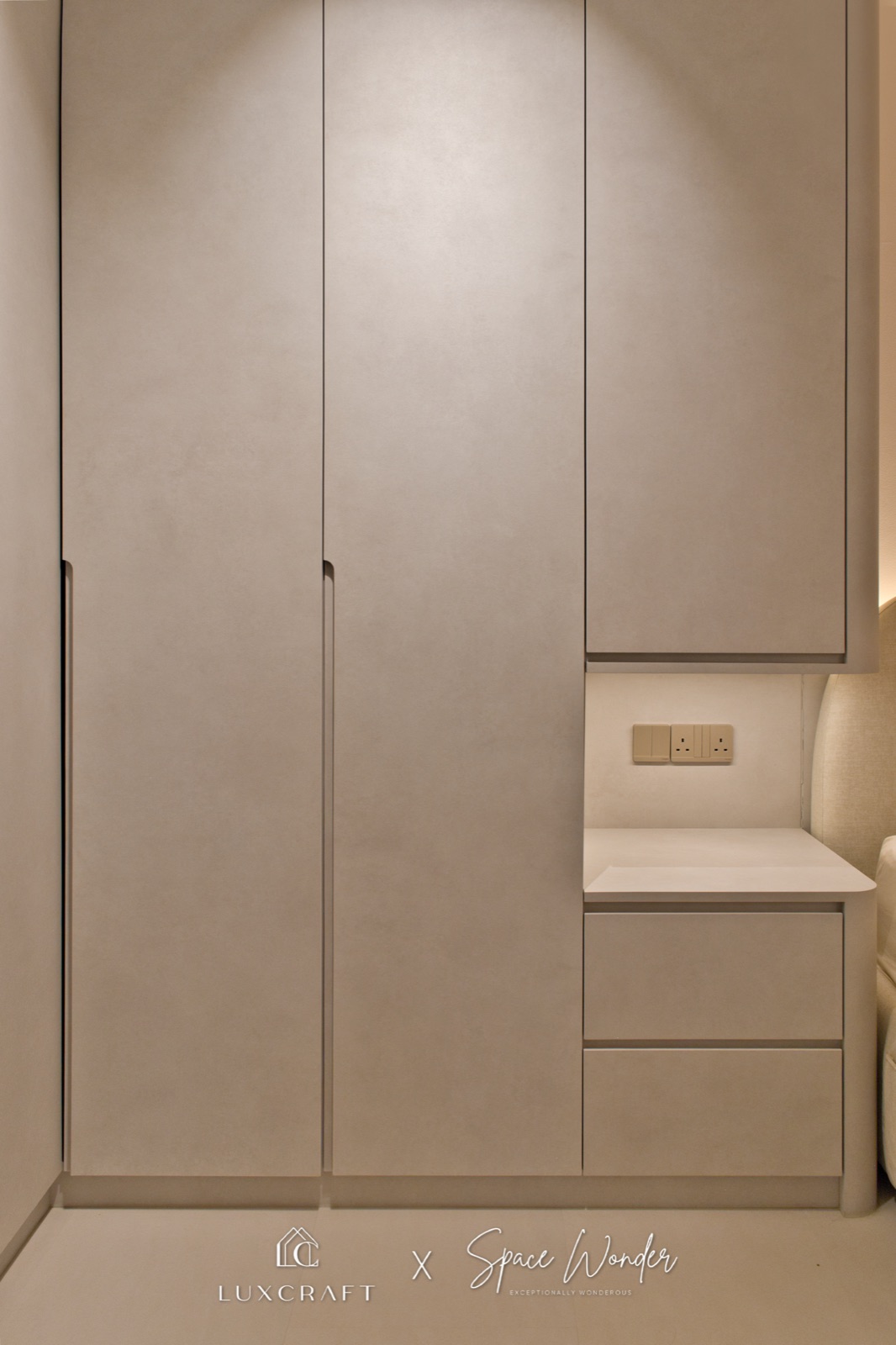
- Master Bedroom Wardrobes: Daily door opening, heavy winter coats, luggage storage, and full floor-to-ceiling maximization make custom plywood wardrobes a prime long-term investment.
- Pantry & Kitchen Island Cabinets: High foot-traffic areas with electrical conduits and heavy dry-food loads.
Zone 2: Smart Opportunities to Save with Loose MDF Furniture
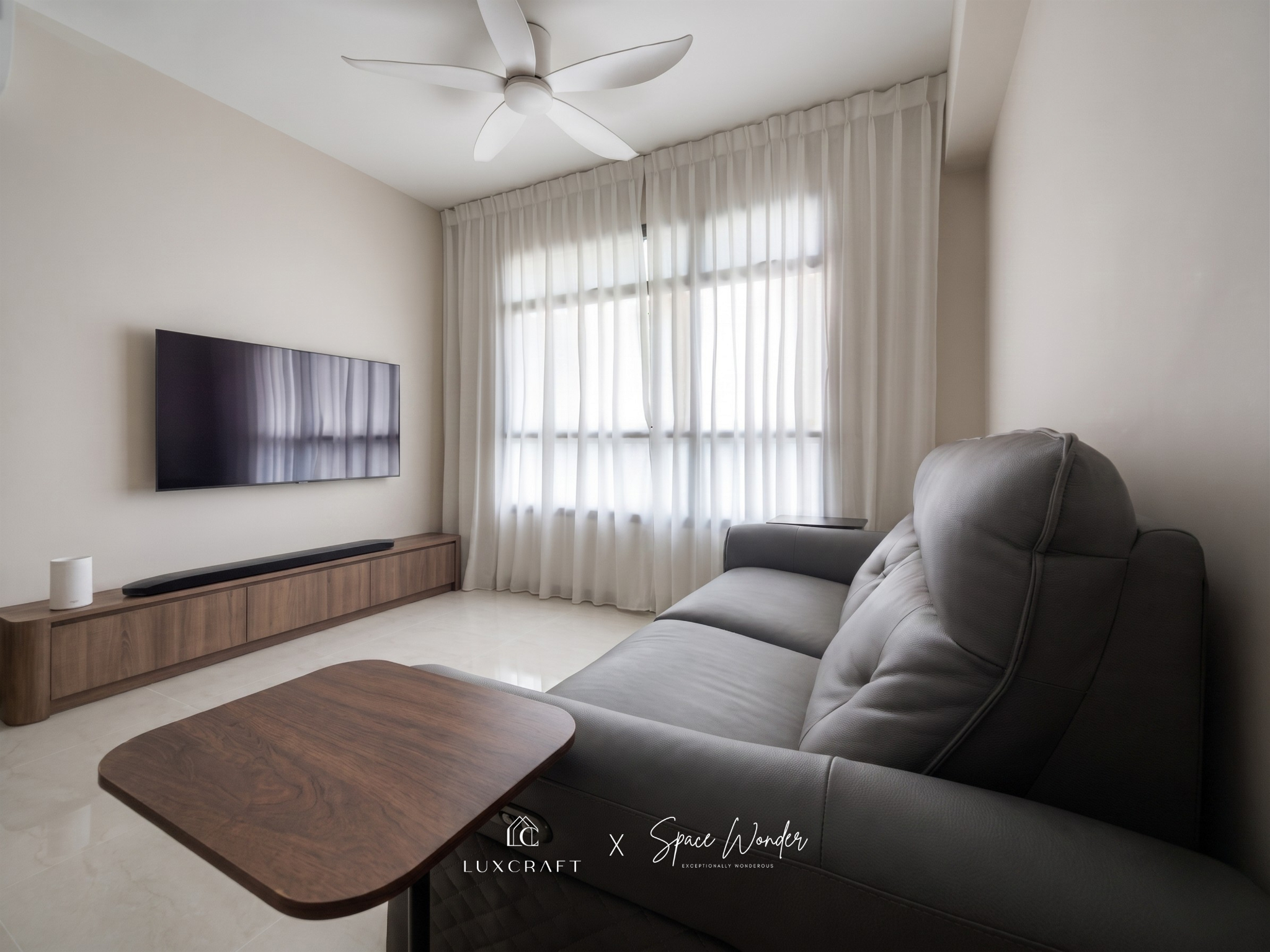
- Living Room TV Console: Positioned in an open, dry, air-conditioned hall with minimal load (TVs are usually wall-mounted). Loose consoles allow you to easily change aesthetic styles every few years.
- Shoe Cabinets: If your shoe cabinet is located along a well-ventilated, dry common corridor or foyer away from rain wash, loose units can serve adequately on a tight budget.
- Guest Room Wardrobe: Guest rooms receive infrequent use and carry minimal clothing loads, making a retail wardrobe a practical cost-saving move.
- Coffee Tables & Accent Nightstands: Loose pieces allow flexibility to rearrange furniture as your family lifestyle grows.
Contractor Insider: How to Ensure You Get Genuine Plywood
When evaluating interior design or carpentry quotations in Singapore, watch out for vague descriptions. Some contractors quote "laminated cabinetry" without specifying the internal carcass substrate.
- Demand "Solid Plywood Carcass": Ensure the contract explicitly specifies solid plywood for cabinet carcasses, drawer bases, and shelving—not chipboard or MDF backings.
- Check Internal Finishes: Premium carpentry uses color PVC or polykem laminate internal carcasses, preventing raw wood exposure and simplifying routine wiping.
- Verify ABS Trimming: High-quality carpentry finishes door edges with 1mm to 2mm ABS edge-banding, which prevents sharp corners and seals against accidental water penetration.
Frequently Asked Questions (FAQ)
Can MDF be used for kitchen cabinets in Singapore if it is laminated?
While laminate offers surface water resistance, steam and moisture in Singapore kitchens inevitably penetrate hinge drillings, handle screw holes, and bottom edges. Once moisture enters an MDF carcass, the board swells irreversibly. Plywood is the only reliable material for Singapore kitchen cabinetry.
Why is custom plywood carpentry more expensive than loose IKEA furniture?
Loose retail furniture is mass-produced in automated factories using cheap wood byproducts (MDF/particle board) in fixed modular sizes. Custom carpentry involves hand-fabrication by skilled carpenters, using high-grade timber plywood, premium heavy-duty laminates, custom spatial measurements, scribing to uneven HDB walls, and on-site professional installation.
How long does built-in plywood carpentry last in an HDB or condo?
Well-crafted plywood carpentry with proper ABS edge-banding and high-pressure laminates typically lasts 15 to 20+ years in Singapore, outlasting multiple generations of loose furniture.
Is plywood heavier than MDF?
No, MDF is significantly heavier and denser than plywood because it is composed of densely compressed wood dust and synthetic resin. Plywood is lighter in density yet significantly stronger and more rigid due to its cross-laminated natural timber grains.
Selecting the right materials for your home isn't just about how things look on move-in day; it’s about how your home holds up five or ten years down the road. If you are planning an upcoming HDB BTO, resale, or condo renovation and want bespoke carpentry built to last, consult our in-house carpentry specialists at LuxCraft.